Saturday, 28 July 2012

Frocks of silk


We are slumberous poppies,
Lords of Lethe downs ...


Poppies for remembrance

 The poppy is the flower of sleep and oblivion. According to Greek legend it was created by the god of sleep, Somnus, to soothe Ceres, the corn goddess, to sleep. When she had rested the corn grew again, giving rise to the belief that poppies are essential for the welfare of the corn. 


Poppy seeds can lie dormant for years and are often stimulated to germinate once the soil is disturbed. Hence the subsequent blooming of poppies on the battlefields of Flanders and why they became the symbol of remembrance for those killed in war.

Frocks of silk

The poppies in the garden, they all wear frocks of silk,
Some are purple, some are pink, and others white as milk,
Light, light, for dancing in, for dancing when the breeze
Plays a little two-step for the blossoms  and the  bees.
Fine, fine for dancing in, all frilly at the hem,
Oh, when I watch the poppies dance I long to dance like them!

The poppies in the garden have let their silk frocks fall
All about the garden paths, but where are they at all?
Here a frill and there a flounce – a rag of silky red,
But not a poppy-girl is left – I think they’ve gone to bed.
Gone to bed and gone to sleep; and weary they must be
For each has left her box of dreams upon the stem for me.
                                                                                    Ffrida Wolfe


Sunday, 15 July 2012

An apple a day


but only after 15th July…

Today is St. Swithin’s Day, a day associated with the weather and the ripening of apples.  His remains were moved from their original resting place to Winchester Cathedral on 15th July in 971 AD. According  to legend, the saint so resented being moved that he began to weep, causing heavy rain to fall for the next 40 days.

Hence, a shower of rain on St. Swithin’s Day was said to be the saint christening the apples and in some rural areas no one would eat an apple until after 15th July.

St. Swithin’s Day, if thou dost rain
For forty days it will remain.
St. Swithin’s Day, if thou be fair
For forty days, ‘twill rain no mair.

The good news is that it stayed fine here the whole day.
Hopefully summer is on the way at last.


Monday, 9 July 2012

Food for the soul


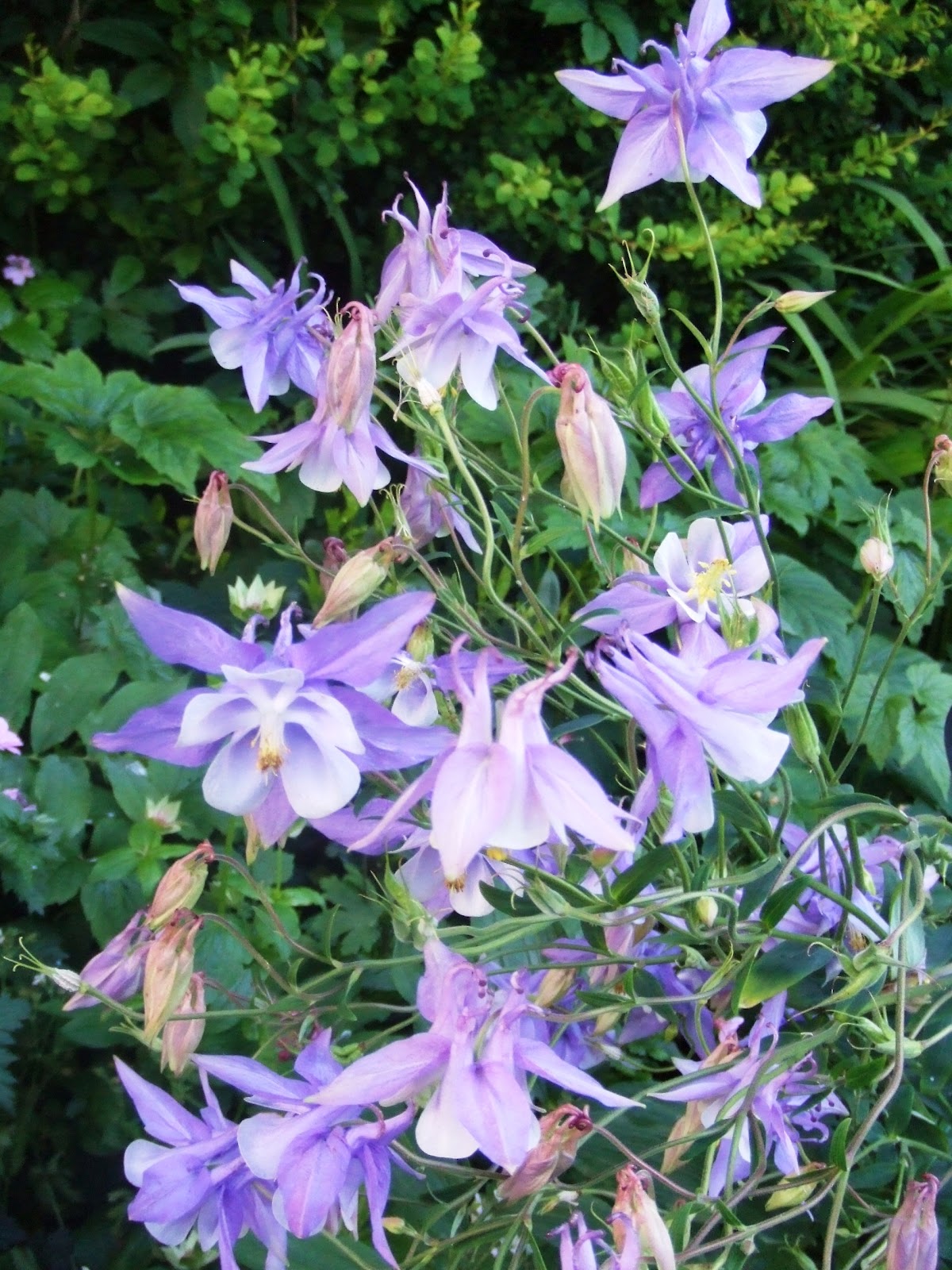
After yet more wind and rain, the garden begins to look battered and almost uncared for with foxgloves leaning perilously, in conflict with yellow loosestrife and deep pink valerian. Leavings from the dreaded geraniums have begun to creep back into the shade of the borders and the dancing fairies have begun their summer striptease.  

Aquilegia - dancing fairies


The replanted border is beginning to establish but, like Thursday’s child, has far to go before it makes real impact, but its colourful promise is inspiring. Meanwhile, many and various clematis twirl and twine about the periphery of the garden fence. 


The alliums stand like purple lollipops, making bullet-like points of reference amongst the euphorbia and knapweed.


Purple Sensation alliums

Bread feeds the body, indeed, but flowers feed the soul     The Koran


Wednesday, 4 July 2012

All the colours of the rainbow


The iris is a flower whose history extends far back in time.
The word is from the Greek, meaning rainbow, but their actual colour spectrum is even wider.

Purple bearded iris

It is possible that the lilies of the fields, which the bible asks us to consider, were in fact iris rather than lilies. The iris has been known for at least two thousand years and the flower has inspired artists and poets alike.  Much loved by Monet at Giverny, blue irises were a favourite subject for Van Gogh.

Mostly grown from rhizomes, irises are well adapted to the British climate and are mainly disease and pest free. The British Iris Society is celebrating its 90th birthday this year, proof positive of how much esteem the plant is held here.


White bearded iris


The plant is very adaptable and there are types that grow in conditions ranging from deep dry shade, even growing underneath trees (iris foetidissima) to full sun (the blowsy bearded variety). Where would spring be without the delicate iris reticulata  and early summer without my personal favourite, the  elegant iris sibirica,  grown in Elizabethan gardens and ponds without the yellow flag iris.

Iris sibirica

The Dog Days begin on 3rd July, and last until 11th August. 

Garden lore tells us that they are linked with the rising of the Dog Star, Sirius, and that these are the hottest days of the year!

Pablo is hoping this is true and keeps looking longingly at the summer house …

Enjoying the summer house ...


Tuesday, 26 June 2012

I know how the flowers felt


 The rain to the wind said
‘You push and I’ll pelt!’
They so struck the garden bed
That the flowers actually knelt –
And lay lodged – though not dead.
I know how the flowers felt.

Valerian
Robert Frost (1874 – 1963)    


The garden remains overgrown and the snails are merrily munching everything in sight. Although I’m not fond of them I merely dislodge them and throw them as far as I can, despite knowing that they stoically turn around and methodically glide back from whence they came.


Rabbits have eaten all the beans and peas on the allotment but as the flowers of the broad bean are said to induce madness and bad dreams perhaps that is no bad thing. 

Yet more snails have chomped their way through my carefully-nurtured sunflowers. I hope to have rescued three - out of a whole seed tray - which is such a pity as each year my huge sunflowers have waved cheerfully to all and sundry as they leaned over the allotment fence. 

White wisteria flowers at last!

I have managed to plant out most of the new perennials for the border, despite the huge deluge on Sunday afternoon that thoroughly soaked both Pablo and me. 


Only fit for entering a wet t-shirt competition, I consoled myself by remembering that my grandmother always maintained that ‘rain was good for the complexion’. She always rinsed her hair in rain water too. Grandma Lee wore her hair in a small, flat bun, held in place under a fine hairnet and I recollect how amazed I was the first time I saw her wash her hair – in a bowl on the table – to see that it reached almost to her waist. 

Proof that rain doesn’t only make plants grow!


Monday, 18 June 2012

St Vitus's Day

15th June was St Vitus's  Day and the rhyme goes

If St Vitus Day be rainy weather
It will rain for forty days together 


Farming lore also promises that 'If on 8th June it rain, that foretells a wet harvest, men sayen'

Dreaming of sunshine

The rain certainly has 'raineth every day', keeping snails and slugs very happy but the rest of us have been very unhappy indeed, including Pablo who kept going to the door, looking out and turning back. He dodged the showers by hiding underneath the cars and to compensate has spent most of June to date asleep.


Unable to garden, I have visited lots of garden centres, trying to decide which plants to buy with my  birthday garden tokens. Because I am able to buy plants, I couldn't decide what to chose and so chunks of the borders are still bare of perennial planting. I have added some pre-sown annuals - salpiglossis, nasturtium and cosmos and have scattered nigella, cornflower and various poppy seeds - but, like a child in a sweet shop, I still can't make my mind exactly what effect I want to achieve but I am enjoying trying to decide.


Finally, today, the rain stopped and the sun came out and Pablo got to spend time in the summer house.


 The garden has become a jungle - a  riotous mix and tangle of weeds and flowers.

Rampant shuttlecock ferns


The smell of new-mown grass - as husband Glynn, in common with most of the neighbours, dashed madly around the lawn, mower at the ready -  together with the glory of the welcome sunshine which lit up the rampant borders to perfection, almost made up for the long wet days.


iris sibirica plus various perennial geraniums


'What is one to 
say about June, the time of perfect young summer, the fulfilment of the promise of the earlier months, and with as yet no sign to remind one that its fresh young beauty will ever fade'

Gertrude Jekyll

Wednesday, 6 June 2012

Through the garden gate...


Gate leading to Wyken Hall garden

Recently returned from a visit to some of the iconic gardens of the South East of England – the highlight of which was Beth Chatto’s garden at Colchester – reinforced the realisation that the best gardens are those which tantalise the viewer and make the visitor want to find out just what is around the corner, exactly what is through that door, and where does that path lead on to?


… Mary had stepped close to the robin and suddenly the gust of wind swung aside some loose ivy trails and more suddenly still she jumped toward it and caught it in her hand. This she did because she had seen something under it – a round knob which had been covered by the leaves hanging over it. It was the knob of a door.

…It was the lock of the door which had been closed ten years and she put her hand in her pocket, drew out the key and found it fitted the keyhole. She put the key in and turned it.

…then she slipped through it and shut it behind her and stood with her back against it, looking about her and breathing quite fast with excitement and wonder and delight.

Through the garden gate...

Planting is crucial of course and all the gardens had been meticulously designed to give variety and year-round colour and interest. Some were a delightful mix of herbaceous and kitchen garden planting, as at the interesting Grimsthorpe Castle and Gardens in Lincolnshire – incidentally home to Zurburan’s original Benjamin – and we’ve just finished sampling  delectable asparagus, freshly picked from their walled kitchen garden.


The glory of the peacock


Rustic fencing

The ancient estate of Wyken Hall in Suffolk, is an Elizabethan manor house, surrounded by four acres of magical garden, including a knot garden, old rose garden, an amazing maze garden with peacocks, guinea fowl and huge black turkeys which, as a vegetarian, I was delighted to learn were also kept as pets. There was also an award-winning   vineyard and a most delightful Leaping Hare shop, described in Country Living as a ‘model of what a shop should be’.

There were also visits to the RHS Hyde Garden, Belton House near Grantham and the National Trust’s Ickworth House with 1800 acres of Capability Brown planting. A summer wedding was taking place whilst we were there and the Italian gardens provided a fairytale backcloth for the champagne reception and photographs. 


... She was standing inside the secret garden.
 
How could one resist ...
 It was the sweetest, most mysterious looking place anyone could imagine. The high walls which shut it in were covered with the leafless stems of climbing roses, which were so thick that they were matted together… one of the things that made the place look strangest and loveliest was that climbing roses had run all over them and swung down long tendrils which made light swaying curtains … It was this hazy tangle from tree to tree which made it all look so mysterious.

       from The Secret Garden by Frances Hodgson Burnett