Wednesday, 6 June 2012

Through the garden gate...


Gate leading to Wyken Hall garden

Recently returned from a visit to some of the iconic gardens of the South East of England – the highlight of which was Beth Chatto’s garden at Colchester – reinforced the realisation that the best gardens are those which tantalise the viewer and make the visitor want to find out just what is around the corner, exactly what is through that door, and where does that path lead on to?


… Mary had stepped close to the robin and suddenly the gust of wind swung aside some loose ivy trails and more suddenly still she jumped toward it and caught it in her hand. This she did because she had seen something under it – a round knob which had been covered by the leaves hanging over it. It was the knob of a door.

…It was the lock of the door which had been closed ten years and she put her hand in her pocket, drew out the key and found it fitted the keyhole. She put the key in and turned it.

…then she slipped through it and shut it behind her and stood with her back against it, looking about her and breathing quite fast with excitement and wonder and delight.

Through the garden gate...

Planting is crucial of course and all the gardens had been meticulously designed to give variety and year-round colour and interest. Some were a delightful mix of herbaceous and kitchen garden planting, as at the interesting Grimsthorpe Castle and Gardens in Lincolnshire – incidentally home to Zurburan’s original Benjamin – and we’ve just finished sampling  delectable asparagus, freshly picked from their walled kitchen garden.


The glory of the peacock


Rustic fencing

The ancient estate of Wyken Hall in Suffolk, is an Elizabethan manor house, surrounded by four acres of magical garden, including a knot garden, old rose garden, an amazing maze garden with peacocks, guinea fowl and huge black turkeys which, as a vegetarian, I was delighted to learn were also kept as pets. There was also an award-winning   vineyard and a most delightful Leaping Hare shop, described in Country Living as a ‘model of what a shop should be’.

There were also visits to the RHS Hyde Garden, Belton House near Grantham and the National Trust’s Ickworth House with 1800 acres of Capability Brown planting. A summer wedding was taking place whilst we were there and the Italian gardens provided a fairytale backcloth for the champagne reception and photographs. 


... She was standing inside the secret garden.
 
How could one resist ...
 It was the sweetest, most mysterious looking place anyone could imagine. The high walls which shut it in were covered with the leafless stems of climbing roses, which were so thick that they were matted together… one of the things that made the place look strangest and loveliest was that climbing roses had run all over them and swung down long tendrils which made light swaying curtains … It was this hazy tangle from tree to tree which made it all look so mysterious.

       from The Secret Garden by Frances Hodgson Burnett

Sunday, 3 June 2012

June is busting out all over


For me, June is the most exciting month in the garden...


Come honey bee, with thy busy hum,
To the fragrant tufts of wild thyme come,
And sip the sweet dew from the cowslip’s head,
From the lily’s bell and the violet’s  bed.

Looking towards the summer house
                                                     Anon


There are more family birthdays in June, including my own, which might have always influenced my preference, but I always associate the month with expectation and promise and, above all, burgeoning perfume in the garden.


Acer among the euphorbias

 The spring bulbs have gone to ground to regroup and prepare for the growing traumas of the following year to come. The borders are beginning to bulk up with perennial planting, which helps impede ubiquitous weeds. The spring shrubs, flowering over, are concentrating on colourful leaf production and annuals are starting to poke their heads tentatively above the soil’s parapet.


In the herb garden, various sages, chives, rosemary, marjoram, oregano, mints, and the dreaded lemon balm are thriving. One of my favourite herbs, lovage, is growing apace and, with its celery-like flavour, is a welcome  accompaniment to meals when used as a vegetable in its own right; it does also make a  wonderful soup, much beloved of the Romans. I wouldn’t be without it in the garden. Angelica doesn’t linger long but friend Terry Ferdinand has promised me sports from his garden so I will try again!
Marigolds beside the pond

In the greenhouse, tomatoes, cucumbers, chillies and sweet peppers are now potted up and ready to face the growing challenge and the promise of coriander, rocket and a mix of delicious basils make mouth-watering progress.

The allotment seems to delight in encouraging perennial weed growth, despite regular weeding forays. Even so, beans, peas, salad crops, early potatoes and rhubarb are almost ready to harvest. Seeds of beetroot and white turnip, are showing promise and purple sprouting broccoli, leeks and celeriac are being nurtured, prior to planting out. 
The glory of white tulips


I can’t wait for the roses in my literary rose bed – Jude the Obscure, The Lady of Shalott, Brother Cadfael, Tess of the D’Urbervilles, Tam O'Shanter and William Shakespeare, to raise their lovely heads and join with sweet peas – aptly, for Pablo’s 1911 garden, the symbol of Edwardian England - to join with me to celebrate the delights of the June garden.


Pity about the rain – but the sun WILL shine - after all it is flaming June

Tuesday, 22 May 2012

Laid upon the landscape with Virginia


From The Virginia Woolf Day Book…

…the windows being open and the book held so that it rested upon a background of escallonia hedges and distant blue, instead of being a book it seemed as if what I read was laid upon the landscape not printed, bound or sewn up, but somehow the product of trees and fields and the hot summer sky, like the air which swam, on fine mornings, round the outlines of things.

From ‘Reading’, Essays II by Virginia Woolf


View of the right hand border from the summer house
Each morning I read that day's quote from my literary heroine's Day Book. 


Today's quote was especially apt, given that summer appears to have arrived and for the first time this year I sat in the sunshine and finished reading my  latest novel selection,  before rescuing the summer bedding from the greenhouse to allow it to get acclimatised in preparation for filling the hanging baskets and yard tubs later this month.

A  task I delight in.
Pablo reclining

Pablo cat ventured out into the garden and lolled on the garden cushions before spying a plate bearing remnants of ice cream, in the summer house, which  he surreptitiously licked clean, without realising he'd been caught on camera!

Pablo tasting...


The borders are beginning to colour up, despite having large empty sections where the offending geraniums have now departed. 

The gate that leads to Pablo's garden

Friend and gardener extraordinaire, Dorothy, has proffered many interesting suggestions for succession planting and we are planning a trip to Egglestone Hall Gardens shortly to remedy the gaps. 


A wonderful time of promise in the garden - a mix of expectation tempered with the gardener's inspiration.


Sunday, 20 May 2012

Invading geraniums


I’ve spent numerous hours trying to dig out perennial geraniums from my borders. They began as the answer to a gardener’s prayer – perfect ground cover for a dry, shady border with very little attention needed and delightful pink and lilac delicate flowers, flowering in early summer with a second flush in autumn - but developed into a monstrous invading army which marched with unceasing momentum, smothering any plant they came in contact with.

Right hand border


With a garden bin full to overflowing and having made a journey to the tip with seventeen bags full of the offending plants, I’m feeling very virtuous and excited at the prospect of new plants for the diminishing borders. I’m pouring over Christopher Lloyd’s wonderful book – Succession Planting for Adventurous Gardeners – for inspiration and enlightenment and am looking forward to a trip to my favourite nursery at Egglestone Hall  where the variety and quality of the plants on offer is second to none.

There’s also a delightful shop, chock full of delicious gourmet treats, managed by the charmingly polite Mrs Harbord of Ladette to Lady fame, (one of husband Glynn's heroines!) and a welcoming coffee shop serving a delicious variety of snacks and light lunches (and it’s licensed.) The gardens at Egglestone Hall are well maintained and include many of the plants available for sale in the extensive nursery - and there’s even a wishing well so do take some pennies!

Putti in the ruined church at Egglestone Hall


It’s a gardener’s paradise this week with extensive TV coverage of the Chelsea Flower Show and I’m extremely envious of friend Avril who is visiting Chelsea in real time later this week. I know she’ll have a poetically wonderful time and will come back home inspired and stimulated by all on offer. 

Comfrey flowers with friendly owl
 
The temperatures are also set to rise to above the seasonal norm so it looks as if summer is on its way at last. Looking forward to eating cherries and sipping a chilled, alcoholic drink in the cool of the evening later this week in the shade of the summer house.

Hopefully Pablo cat will be joining me.

Cheers


Tuesday, 15 May 2012

Tulipomania


The tulip is named from the Turkish word for turban, duliband, in reference to its shape and form. They were introduced into Western Europe in the sixteenth century. By the seventeenth century in France no woman would be seen without a bunch of the blooms tucked into her bosom and within a few years bulbs were changing hands for fantastic sums.


The craze swept through Flanders into Holland where the Dutch developed a passion for them. Bulb growers vied with each other to produce more exotic varieties and bulbs changed hands for exorbitant prices.


A marvellous fictional account of the Dutch involvement in the tulip trade, Tulip Fever by Deborah Moggach, with a marvellously ironic ending, is a must-read for all tulip lovers. (Incidentally, Deborah wrote the book on which the recent film, The Best Most Exotic Marigold Hotel, is based. At one point, the Penelope Wilton character is shown lounging in a deck chair, reading – you guessed it – Tulip Fever!)

Lily-flowered tulips
Each year I invest in yet more tulips – especially the lily-flowered variety which are my personal favourites. With pointed, reflexed petals they are unsurpassed for elegance. Sadly, they often only survive for one year. Garden lore tells that tulips will not thrive if left in the same spot for more than two years running and should be left to die back before being lifted and moved to fresh soil to prevent them from suffering from tulip blight.

One of the finest tulip displays can be seen at Constable Burton Gardens, near Leyburn - a perfect opportunity to Tiptoe through the Tulips…


Tuesday, 8 May 2012

Going down the Amazon


A touch of the Amazon in Durham…

Victoria amazonica
Unmissable currently at Durham’s University Botanic Gardens is the Amazon Water Lily – Victoria amazonica. Housed in one of the greenhouses in its own specially prepared pool, it grows up to eight feet across in the wild and can allegedly support the weight of a man.(I haven’t checked yet with Head Gardener, Mike, if any of his staff have tried to prove that this is actually so).

Close up of leaves
This water lily was discovered in Brazil in the nineteenth century and thus was named after Queen Victoria. The ribbed structure of the leaves was said to have provided the inspiration for Joseph Paxton’s glasshouses at Chatsworth and the Crystal Palace Exhibition of 1851.

The undersides of the leaves are riddled with amazing spines to stop them being munched by passing fish, but it is the fantastic flower which is the show-stopper. 

 It looks just like a regular water lily but is in proportion to the size of the gigantic leaves and literally is Amazonian! It is such a treat to have the opportunity of seeing it and, although the flower will last some while yet, I urge you to make the effort to view it.


Despite the splendour of this exotic delight, perfect for all would-be Thumbelinas, I have to agree with Schumacher, however,  that ‘small is beautiful’ and can hardly wait for the pygmy water lily in my own miniscule garden pond to flower.

Wednesday, 2 May 2012

And after April ...


When May follows
And the white-throat sings and all the swallows,
Hark, where my blossomed pear tree in the hedge
Leans to the fields and scatters on the clover
Blossoms and dewdrops at the bent sprays edge …


Flowering cherry

 April traditionally is associated with blossom and this April didn’t disappoint until the weather turned against us, destroying the blossom on many prunus (flowering cherries) trees before we had time and opportunity to fully appreciate their breathe-taking beauty. Fortunately the apple blossom hasn’t been affected and I’m hopeful for a good harvest later in the year.


Early apple blossom
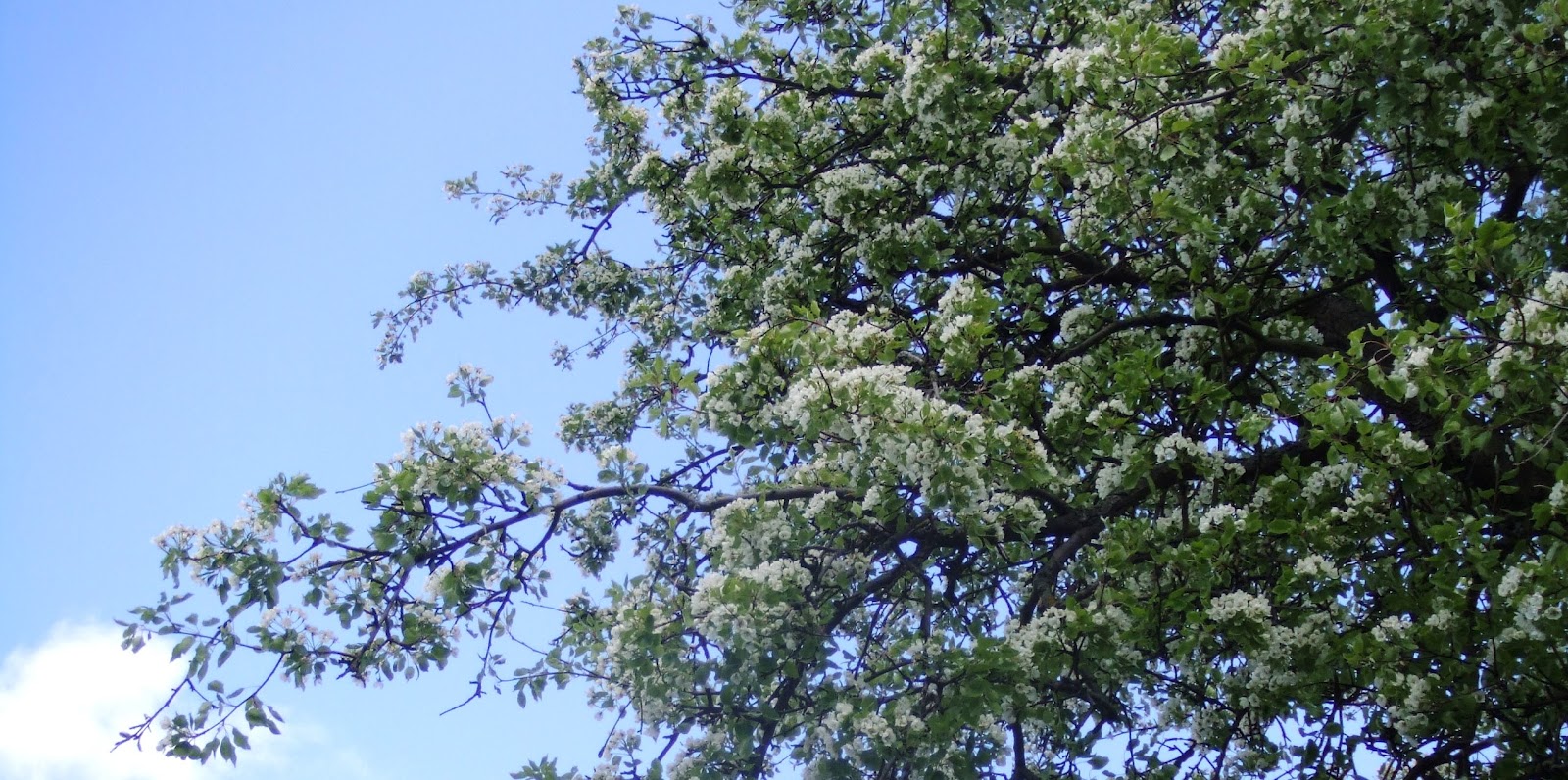
Similarly with pear tree blossom. We have two extremely large and ancient pear trees – they are possibly as old as the house itself which was built in 1911. The tree nearest the house bears the most wonderful, juicy pears which, when we first moved here in 1979, we gathered by standing on a neighbour’s flat-roofed garage and which we transformed into wonderful jams, chutneys and, to my mother-in-law Rouena’s delight, a very intoxicating pear wine, which when left to mature in the under-stairs cupboard until the cupboard was spring cleaned the following year, almost took on the status of a fine spirit. Sadly for us, the tree is now so large that only the starlings and crows benefit from the mouth-watering fruit.

Old pear tree with delicious fruit, sadly enjoyed only by the birds!

The second tree bears a small, hard fruit in large quantities. Again the tree is too large to enable us to harvest the fruit but, happily, most of the pears are blown onto the lawn by the autumn strong winds and are easily harvested as wind-fall fruit. Thus they don’t keep for long but even so are delicious eaten au naturelle;  stewed in the microwave and eaten with Greek yoghurt; or made into pear pickle or chutney - delicious when eaten with cheese and celery for a quick and tasty supper.

Roll on autumn - my mouth is watering already…